
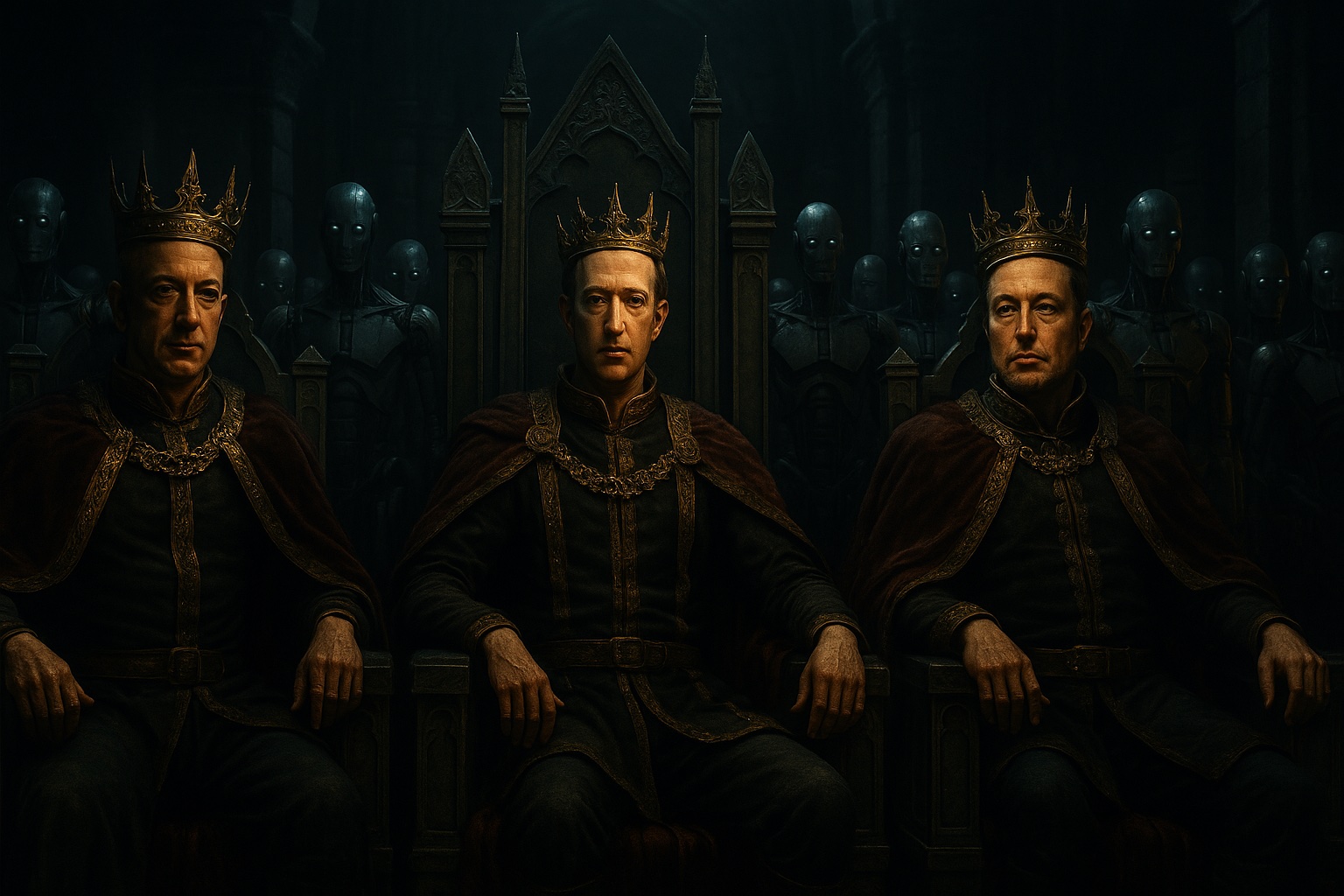
The three richest men in the world – Elon Musk, Jeff Bezos and Mark Zuckerberg – all sat in the front row at Trump’s inauguration, and the cabinet was relegated in the second row. There could hardly be a more telling image of a new world order.
The first couple of months of the Trump presidency have effectively buried any notion that this administration will adhere to the norms of democracy under a rubble of executive orders and administrative hubris and insanity.
Elon Musk has been up front and center as the so-called head of DOGE, the new «Department of Government Efficiency.» And, his unhinged behaviour and frantic support for Trump have been in the news since he invested in the Trump candidacy.
How all the tech-leaders of the major companies decided to («goose) step in line, and hail the new president merits some analytical effort to discover other motives, and mechanisms at play, besides the gigantic tax-cuts offered as payment.
Deterritorialization and Reterritorialization of Power Flows in the Digital Age
The triumvirate of Bezos, Musk, and Zuckerberg represents not merely individual capitalists, but rather nodal points in what French philosopher Gilles Deleuze (1925-1995) probably would have referred to as a new “machinic assemblage” of control.
“Machinic assemblage of control” is a concept developed by Deleuze in his analysis of Foucault’s work on power. It refers to the ways in which power operates in contemporary societies, not through centralized institutions or ideologies, but through a network of decentralized and interconnected mechanisms.
Machinic: Deleuze uses the term “machinic” to emphasize the impersonal and automated nature of control mechanisms. They are not simply imposed from above, but rather emerge from the interactions of various elements within the social field.
Assemblage: This term highlights the heterogeneous and contingent nature of control. It is not a unified system, but rather a collection of disparate elements that come together to form a functioning whole. These elements can include technologies, institutions, discourses, practices, and even affects.
Control: Deleuze distinguishes between “disciplinary societies” of the past, which operated through confinement and surveillance, and “control societies” of the present, which operate through modulation and continuous monitoring. In control societies, individuals are not confined to specific spaces, but rather are constantly tracked and guided through various feedback mechanisms.
The concept of “machinic assemblage of control” helps to understand how power operates in a more diffuse and decentralized way today. It is not simply a matter of top-down domination, but rather a complex interplay of various forces that shape individual behavior and social life.”Machinic assemblages of control” is represented in:
Social media platforms: These platforms collect vast amounts of data about users, which is then used to target them with personalized advertising and content. This can be seen as a form of control, as it shapes users’ choices and preferences.
Surveillance technologies: Facial recognition software, CCTV cameras, and other surveillance technologies are increasingly used to monitor individuals’ movements and activities. This can lead to a chilling effect on freedom of expression and association.
Algorithmic management: In many workplaces, algorithms are used to monitor and evaluate employees’ performance. This can lead to increased stress and anxiety, as well as a loss of autonomy. Amazon uses algorithms to track workers’ productivity in warehouses and even generate paperwork for terminating employment if targets are not met.
Deleuze’s concept of “machinic assemblage of control” is a complex and nuanced one, but it provides a valuable framework for understanding the ways in which power operates in contemporary societies.
These tech oligarchs operate through what Deleuze termed “societies of control,” where power is exercised not through traditional disciplinary institutions, but through continuous modulation of behavior via digital platforms and algorithmic governance. Their companies – Amazon, Tesla/X, and Meta – function as desiring-machines that capture and redirect the collective desires of billions of users.
A desiring-machine constantly produces connections and flows. We are all desiring machines (no matter how poorly assembled), and characterised by productive «creativity». We tend to see the latter in an «artistic» context (thus positive), but it is simply the capacity to create something good or bad.
The desires which flows we are caught up in are not necessarily productive and beneficial for us, and especially if these powerful «monster machines» have an excess of personal data, their capacity to manipulate our desires are frighteningly all encompassing.
The rhizomatic* nature of the tech-oligarch power structures differs from traditional hierarchical models. Rather than ruling through direct force, they establish control through data flows, digital infrastructure, and platform dependencies. Amazon’s logistics network, Tesla’s transportation revolution, and Meta’s social graphs create new territories of control while simultaneously deterritorializing traditional state power.
These oligarchs embody what Deleuze and Guattari called “axiomatics of capital” – they don’t merely accumulate wealth, but rather reconfigure the very channels through which desire, information, and capital flow. Their power is not merely repressive but productive, generating new forms of subjectivity tied to their platforms and technologies.
Yet within this system lie the seeds of its own deterritorialization. The very networks that enable their control also create possibilities for new lines of flight – decentralized technologies, platform cooperatives, and emergent forms of digital and physical resistance that could potentially escape or subvert the oligarchic assemblage.
The prime example is Tesla. The identity of the brand that conquered car-buyers globally wasn’t that of an «electric-car company». Tesla represented «Future», «Sustainability» and «Luxury»” to those that bought in to the story. However, due to Musk’s machinations as leader of DOGE, and his Dr.Strangelove-like inability to keep his right-hand from making a nazi-salute, this identity is rapidly being deterritorialized into «Swasticar».
The fall of Tesla illustrates the speed of deterritorialization in a hyper-information era. The excessive volume and speed of information is simultaneously a «rocket» and a «shooting star». That is, information shoots by «at the speed of light», but when enough «lines of flight» align, deterritorialization takes off into the stratosphere.
The lines of flight are inherently creative, an outside of the system gravitating towards a potential unknown materialization. In an «assemblage» like the oligarch power-structure, these lines criss-cross narratives, stated ideologies, technology, consumer trends, politics etc. The weight put on consumerism has opened «cracks» in the assemblage, and the consumer is now reconstructing both the relationship with the tech-titans as well as their companies and products.
#Rhizome – unlike a tree with a central root and branching structure, a rhizome has no single origin or central point. It’s a network of connections that can extend in any direction.