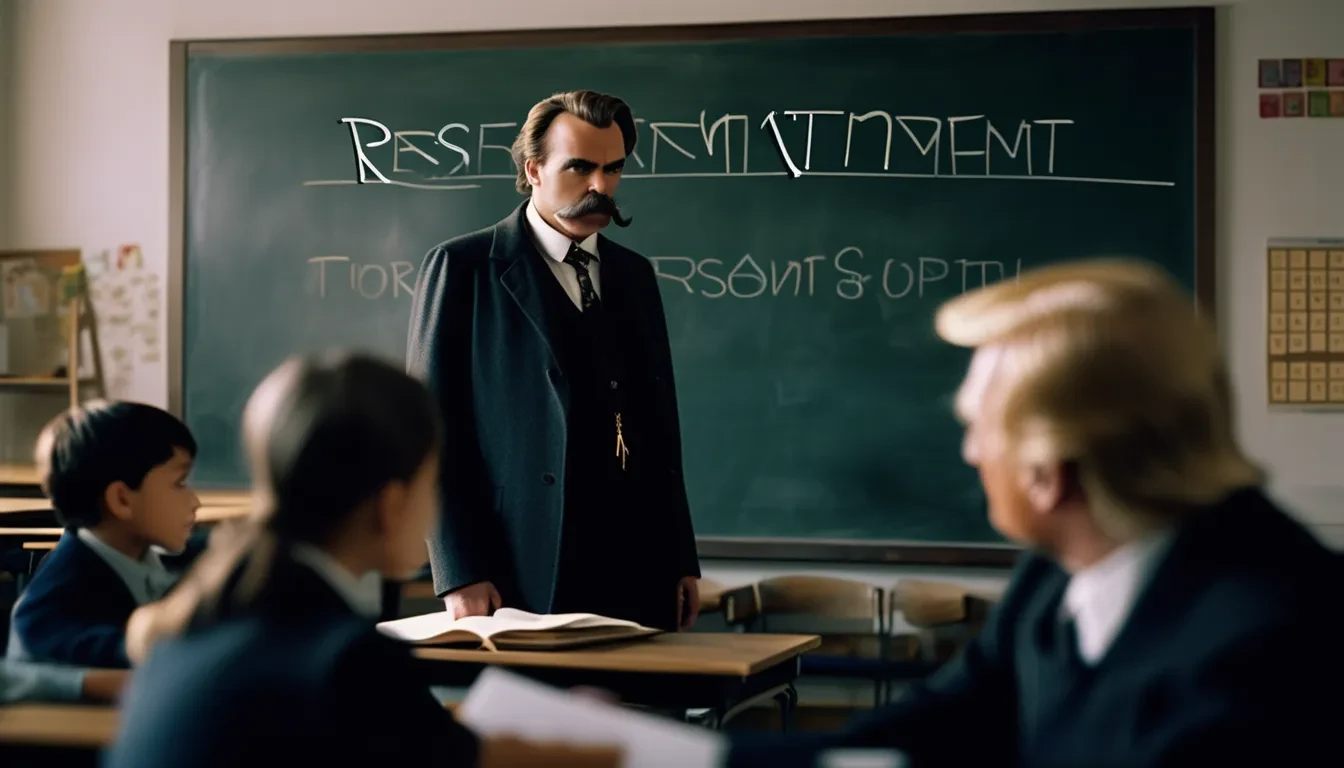
If I want to make sense of life, I often turn to my favorite Germans, sometimes it’s Bach, sometimes it is Nietzsche. In the case of understanding the success of another individual of German descent, Donald J. Trump, unfortunately the former can’t really help (other than transport your mind from the stark reality of Trump having nuclear codes).
Friedrich Nietzsche, on the other hand, offered an understanding of human nature that is of great help in unwrapping the «incomprehensible» outcome of the 2024 US presidential election.
In «Beyond Good & Evil» (1886) he tackles the mechanisms of morality, truth and religion. One central concept is that of «ressentiment». This refers to a form of reactive emotional response rooted in feelings of powerlessness or resentment, often directed at perceived elites, institutions, or privileged groups. It leads to a moral inversion where the “weak” reframe their lack of power as a virtue and the power of the “strong” as evil or oppressive.
I’d argue that «ressentiment» was the central vehicle throughout the election, and drove Trump all the way to 1600 Pennsylvania Avenue NW, Washington, DC.
Five Key Aspects of Ressentiment in Trump’s Election
- Perception of Marginalization: Nietzsche argued that ressentiment thrives in contexts where individuals or groups feel disempowered or excluded. Trump’s campaign capitalized on widespread frustrations among working-class and rural Americans who perceived themselves as left behind by globalization, deindustrialization, and cultural shifts. These voters often felt alienated by the perceived “elites” and mainstream political establishments.
- Cultural and Moral Inversion: Nietzsche’s analysis of ressentiment includes the creation of new moral values that redefine the “good” as the oppressed, pure, or authentic, and the “bad” as the powerful, corrupt, or elitist. Trump’s rhetoric often appealed to this dynamic, portraying himself as the champion of the “forgotten man and woman” against the corrupt elite. His outsider status and disdain for political correctness resonated as authentic and virtuous to his base, while traditional political figures were framed as untrustworthy and morally bankrupt. Pulling off this trick was perhaps Trump’s greatest «accomplishment».
- Reactive Identity Politics: Nietzsche suggested that ressentiment leads to the construction of identity in opposition to perceived oppressors rather than through intrinsic affirmation. The election saw the rise of a collective identity among many Trump supporters defined by opposition to liberal elites, globalists, and the media. This reactive energy was central to Trump’s appeal and to the emotional fervor of his base. Undoubtedly this was accelerated by many feeling that their own identity was under threat, from real (economical and demographical shifts) and perceived ( a «conspiracy» to change gender and sexual orientation of children) enemies.
- The Mechanics of Scapegoating: Ressentiment often involves projecting blame onto others. During the campaign, Trump frequently targeted immigrants, international trade deals, and foreign nations (e.g., China, Mexico) as scapegoats for America’s economic and cultural challenges. Nietzsche would interpret this as a mechanism through which disempowered groups channel their frustrations and affirm a sense of righteousness.
- The «Strong Leader» as the Solution: Interestingly, Nietzsche also critiques leaders who exploit ressentiment to gain power rather than encouraging individuals to transcend it. Trump’s persona as a wealthy, self-assured outsider who “tells it like it is” provided a paradoxical figure of empowerment for his base. Nietzsche would most likely see Trump as both a product of ressentiment and someone who manipulates it without genuinely offering a path beyond it.
The Consequences of Resentment Politics
Nietzsche’s framework invites reflection on the validity of politics grounded in ressentiment. While it can galvanize support and foster a sense of belonging among disaffected groups, it perpetuates cycles of blame and opposition without addressing underlying inequalities or fostering individual or societal growth. Trump’s election highlighted the power of ressentiment in mobilizing political change but also underscored its potential divisiveness and limitations in promoting long-term cohesion or progress.
A «Post-Truth» Perspective
Nietzsche’s perspectivism suggests that there are no objective truths, only interpretations shaped by individual and collective perspectives, power dynamics, and underlying psychological drives. Trump’s campaign and subsequent presidency can be viewed as a quintessential expression of what Nietzsche might call a “master morality”; a mode of political engagement that creates its own value system, unbound by traditional moral constraints. His political rhetoric deliberately shattered conventional political discourse, presenting a narrative that was less about factual accuracy and more about emotional resonance and perceived strength.
The election revealed the fragility of established political “truths.” Trump’s success demonstrated how interpretative frameworks are not fixed but constantly negotiable, reflecting Nietzsche’s critique of absolute moral systems. His supporters interpreted political reality through a lens that prioritized cultural resentment, economic anxiety, and a desire to challenge perceived elite narratives.
Nietzschean perspectivism would argue that Trump’s political ascendancy was not about revealing an objective political reality, but about constructing a compelling narrative powerful enough to reshape collective perception. His ability to dominate media discourse, to create his own version of truth through outrageous statements, and to redefine political communication exemplifies the Nietzschean concept of truth as a “mobile army of metaphors.» (from “On Truth and Lying in an Extra-Moral Sense”)
While Nietzsche used Perspectivism as a tool to challenge the notion of absolute truths and striated moral concepts, Trump uses it to create a «post-truth» environment where «alternative facts» have, not only equal value to established facts, but even more value if they resonate significantly with resentment («ressentiment»).
Arguably, the Democratic Party failed to address the challenge of «ressentimient» by being focused on «the middle ground», trying to convince moderate conservatives to vote for them, while Trump was given «free reigns» to spin his narrative of «the elites» vs «regular folk». How much of this was a conscious strategy is anybody’s guess, it worked. And, Nietzsche would have told you so!