
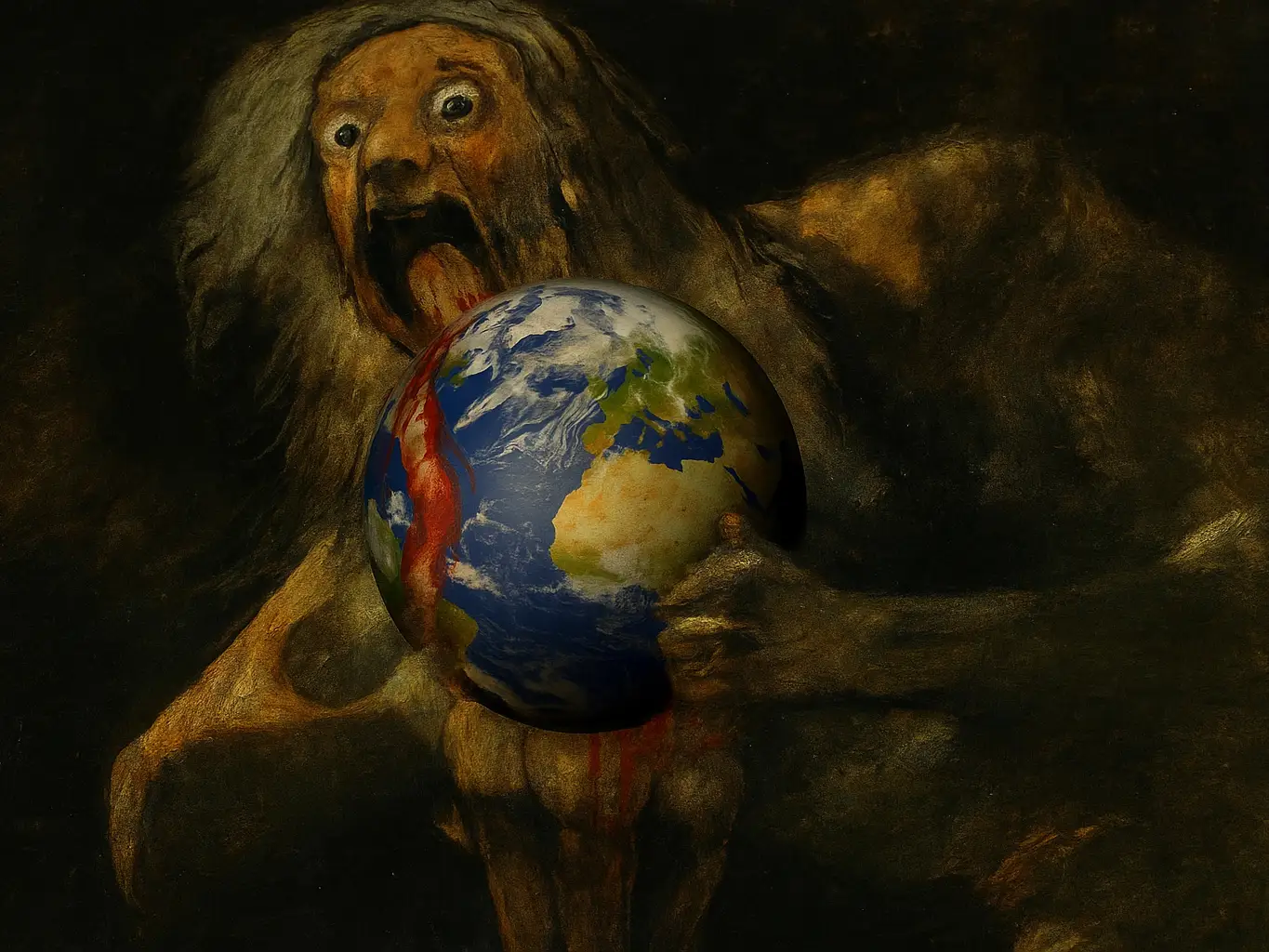
Quite a few things baffle me in this world, why Oasis, Coldplay and Nickelback exist, the «deification» of Taylor Swift, why people drive Cybertrucks. The list goes on. But, nothing baffles me more than the morbid desire of the likes of Elon Musk, Jeff Bezos, Mark Zuckerberg and all the other mega-rich of their ilk.
To explore this, I’d like to lean on two guys who also baffle me, as well as astound, challenge and enlighten, French post-structuralists Félix Guattari (1930-1992) and Gilles Deleuze (1925 -1995). Their concept of desire (a red thread through most of their works) is far more all-encompassing than the physical side of the concept.
In Anti-Oedipus, Gilles Deleuze and Félix Guattari revolutionized our understanding of desire, rejecting the psychoanalytic model that views desire as lack or absence. Instead, they positioned desire as a productive force; a machine that creates connections, flows, and assemblages.
Perversion of Production
For Deleuze and Guattari, healthy desire operates as a “desiring-machine” that produces reality through its connections with other machines, objects, and bodies. It is fundamentally creative, seeking new assemblages and territories. This creative and positive force does, however, become, morbid when billionaires exhibit a form of desire that has become reterritorialized around a single object: capital itself. This represents a fundamental perversion of desire’s productive capacity, transforming it from a force of creation into an engine of morbid accumulation.
The morbidity of billionaire desire manifests in its compulsive, repetitive nature. When individuals like Bezos, Musk and Zuckerberg whose net worth exceed the GDP of about 60-70 countries, continue to frantically accumulate wealth while underpaying workers, and undermining democracy, this suggests a desire-machine stuck in a feedback loop, unable to deterritorialize onto new planes of existence. This is not the smooth, flowing desire that Deleuze and Guattari celebrate, but rather a blocked, overcoded desire that has become pathologically fixated.
Bodies Without Organs Gone Rigid
What makes this desire particularly morbid is its relationship to death, not physical death, but the death of possibility. In Deleuze and Guattari terms, morbid desire operates through what they call “molar lines” rather than “molecular lines.” It seeks rigid hierarchies, fixed identities, and static accumulations rather than the fluid becomings that characterize healthy desiring-machines. The billionaire’s desire becomes a “body without organs” in the negative sense, not an open field of possibilities, but a closed system that resists new connections and flows.
This pathological intensification occurs through what we might call “desire-capture.” The capitalist machine has successfully channeled and concentrated desire through mechanisms that trap it within circuits of endless accumulation. The billionaire becomes a kind of “black hole” in the social field, drawing resources, attention, and energy into an increasingly dense singularity that produces nothing but its own expansion. Unlike healthy desire, which creates new territories and possibilities, morbid desire creates only more of itself.
A tragic side of this, is that we are all sucked into these «black holes» through our own misdirected desires. The desire-capture builds increased velocity through a public discourse dominated by Social Media where algorithms are constructed to propel an «auto-productive» desire, that is a desire that only folds in on, and duplicates itself. This morbid desire exhibits what Deleuze and Guattari would describe as “paranoid” characteristics.
It becomes defensive, protective of its accumulated territories, and increasingly disconnected from the (real) social machines that originally enabled its productive capacity. The billionaire’s desire turns inward, creating elaborate structures (trusts, foundations, security apparatus) designed not to produce new connections but to preserve existing accumulations against potential loss or redistribution. The social implications of morbid desire extend beyond individual psychology.
Mechanisms of Control
When desire becomes concentrated in these pathological formations, it creates what Deleuze and Guattari call “fascist” tendencies, not necessarily political fascism, but the fascism of desire itself. This manifests in the billionaire’s tendency to seek control over increasingly large social assemblages: media companies, political processes, technological platforms, even space exploration.
Yet Deleuze and Guattari’s framework also suggests possibilities for intervention. Desire, even in its morbid forms, retains its fundamentally productive character. The challenge lies in creating conditions for deterritorialization; breaking apart the fixed assemblages that trap desire within accumulative circuits and opening new lines of flight toward more life-affirming connections.
The concept of morbid desire illuminates how capitalism’s greatest success stories represent, paradoxically, desire’s greatest failures. The billionaire embodies not desire’s triumph but its capture and pathologization. Viewing this phenomenon through a Deleuzian lens offers both an understanding of extreme wealth concentration and a vision of what desire might become if liberated from these morbid assemblages, flowing once again toward the production of life rather than the accumulation of death.